Online applications, direct enrolment, financial support, transport and pre-enrolment forms will be unavailable from Friday at 4:30 pm until Monday morning. View update.
What can this course lead to?
By the end of this Apprenticeship the candidate will have satisfied the requirements for registration as EngTech by the Engineering Council through The Chartered Institute of Plumbing and Heating Engineering (CIPHE) and or The Chartered Institute of Building Services Engineers (CIBSE).
On completion of the health and safety assessment, as determined, by the assessment plan the candidate will have satisfied the requirements to obtain a Construction Skills Certification Scheme (CSCS) Card through the Joint Industry Board for Plumbing and Mechanical Engineering Services (JIB-PMES) at the appropriate grade.
Job roles include: Plumber, Domestic Heating Engineer Domestic Heating Installer, Plumbing and Domestic Heating Installer and Plumbing and Domestic Heating Engineer.
Who is it for?
Please only apply for this Apprenticeship Course if you already have a suitable employer.
Do you enjoy practical work and want to develop a skill you can use in different ways?
Are you looking to start a career within the plumbing and heating industry or upskill for an existing role?
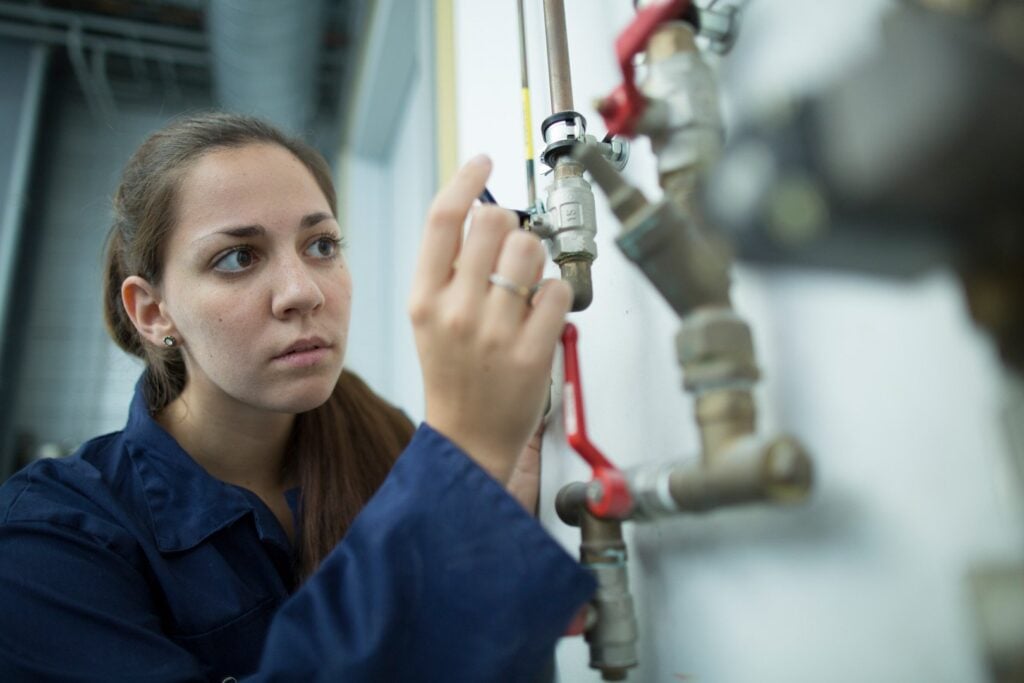
Plumbing and Domestic Heating Technicians plan, select, install, service, commission and maintain all aspects of plumbing and heating systems. As an Apprentice, you will work towards becoming competent with the installation of plumbing and heating systems including accurate measuring, marking, cutting, bending and jointing metallic and non-metallic pipework.
You could be working on appliances and equipment including gas, oil and solid fuel boilers, as well as pumps, heat emitters, bathroom furniture or controls as part of cold water, hot water and central heating systems, along with above-ground drainage and rainwater systems. You will be part of an industry at the forefront of installing new and exciting environmental technologies like heat pumps, solar thermal systems, biomass boilers and water recycling systems. It is essential that you develop the knowledge, skills and behaviours to work independently or as part of a team, installing systems to the latest industry standards.
In addition to the core skills and knowledge requirements of this standard, you will choose a specialism from the following:
- Option 1: Fossil Fuel – Natural Gas
- Option 2: Fossil Fuel – Oil
- Option 3: Fossil Fuel – Solid Fuel
- Option 4: Environmental Technologies
We advise discussing these options with your employer before starting your Apprenticeship to ensure they can support you.
You can apply for an Apprenticeship if you are living in England, over 16 and not in full–time education. You must be in paid employment for the duration of your Apprenticeship course; you cannot be self–employed or a volunteer. Employers must pay you the minimum Apprenticeship wage or more for a minimum of 30 hours a week.

What is covered?
Core Knowledge and Behaviour Requirements
- Health and safety – understand health and safety legislation, codes of practice and safe working practices.
- Core plumbing systems – understand selection, planning, installation, testing, commissioning, de-commissioning, service, maintenance, fault diagnosis and repair techniques on cold water, hot water, central heating, above-ground drainage and rainwater systems.
- Electrical components and control systems – understand installation and testing techniques for electrical components and control systems on plumbing and domestic heating systems.
- Plumbing science and processes – understand scientific plumbing, domestic heating and mechanical principles.
- Principles of environmental technology systems – understand the principles of domestic mechanical environmental technology systems.
- Principles of fossil fuels – understand the principles of fuel combustion, ventilation and flue arrangements within a domestic environment.
- Customer service – understand the principles of high-quality customer service and identifying the needs of others. Respect the working environment including customers’ properties.
- Communication – understand different communication methods, how to communicate clearly and appropriately, and how to adapt communication style to suit different situations.
Skills
- Safe working – operate safely by adhering to health and safety legislation, codes of practice and safe working procedures.
- Core plumbing system techniques – apply selection, planning, installation, testing, commissioning, de-commissioning, service, maintenance, fault diagnosis and repair techniques on plumbing and heating systems.
- Electrical components and control systems techniques – apply installation and testing techniques for electrical components and control systems.
- Supervisory skills – take responsibility for your own work and the safety and welfare of others; oversee and organise work programmes and the work environment; manage resources in an environmentally friendly manner.
In addition to the core skills and knowledge requirements, Apprentices (with support from their employer) must choose one of the following specialisms:
- Option 1: Fossil Fuel – Natural Gas
- Option 2: Fossil Fuel – Oil
- Option 3: Fossil Fuel – Solid Fuel
- Option 4: Environmental Technologies
You will be expected to attend college 1 day a week as part of your off-the-job training. Additional off-the-job training hours are expected to be completed within your workplace, although you may also be asked to complete tasks at home via Google Classroom and OneFile.
Frequently Asked Questions (FAQs)
Minimum GCSE Grade 4/C in English and maths.
As well as being assessed continually throughout your Apprenticeship course, all Apprentices are required to complete an End–point Assessment (EPA) in order to complete their qualification.
The EPA is conducted independently of your employer and Peterborough College and is designed to test whether you have gained the skills, knowledge and behaviours outlined in the Plumbing and Domestic Heating Apprenticeship Standard. You will be graded according to your individual performance.
Throughout the duration of your Apprenticeship, you will complete the Level 3 Plumbing and Domestic Heating qualification before taking the End-point Assessment. Only when this qualification has been completed can your assessor and employer agree to put you forward for the ‘Gateway’. This allows you to focus on and prepare for your EPA. During this period, your employer will be expected to support you through regular training and guidance.
Throughout the Apprenticeship, it is your responsibility—with support from your employer, assessor and college tutors—to ensure you are ready for your final independent EPA.
More information about your EPA will be given to you by your Assessor at the Apprenticeship Sign Up.
Learners may need to purchase uniform and/or equipment depending on the employer. Mandatory PPE will be provided by the employer free of charge.
Apprentices may be required to apply for an Apprentice CSCS card, which may involve an additional cost. There is no requirement for the employer to support you with this cost, so you would need to discuss this directly with your employer.
All candidates will be invited to an informal interview and initial assessments in English and Maths with an Apprenticeship Recruitment Officer.
Reality Check!
A plumbing Apprentice could expect to work unsociable hours, weekends and even be on 24-hour call-out service. An Apprentice will work on average 30 hours a week, although this may vary throughout the year depending on seasonal trends and workloads.
Working conditions may sometimes be confined and you may have to work outside in all weathers. You may also be required to work at height, outside buildings or on rooftops.
You will be expected to demonstrate good customer service skills, ensuring your work is tidy and respectful of others, as you could be working in customers’ homes as well as on building sites.
Newly qualified plumbers may earn a starting salary of between £16,500 and £21,000. An experienced plumber may earn from £21,000 to £35,000.
As an employed status Apprentice you will:
- Earn a wage – the national minimum wage for Apprentices is £7.75 an hour, although many Apprentices earn more than this. You must be a paid employee of the business; you cannot be self-employed or a volunteer.
- Have a contract of employment – this must be provided at the start of your employment.
- Get paid holidays – details will be outlined in your contract of employment.
- Receive training – it is crucial to the success of your Apprenticeship that your employer supports you with regular training. The Apprenticeship standard requires you to complete off-the-job training, which will include training at Peterborough College and workplace training. You will also be expected to build a portfolio and complete tasks on OneFile and Google Classroom.
The College has supported me through thick and thin – especially Ryan Lewis and the other Bricklaying tutors. I wasn’t confident in myself, but Stamford College has really bought me out of my shell and helped me to become the person that I am today.
Part of the Inspire Education Group © 2025 All rights reserved.